Blue Catfish
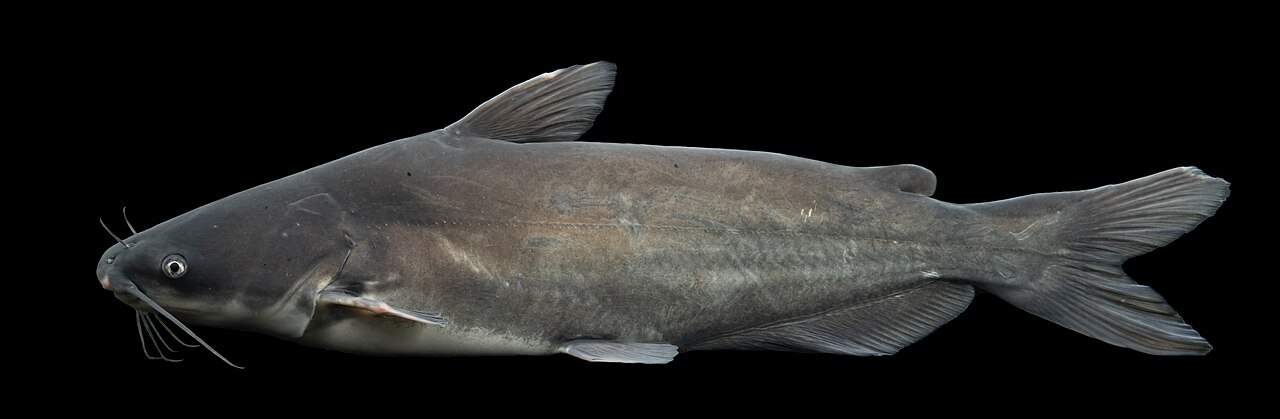
Ictalurus furcatus. Never has the dark spots seen on channel catfish; body is pale slate-blue to silvery, fading to white on the belly.
Photos
Click a photo to expand it for a closer look.
_(53011311615).jpg)
Identification
- Never has the dark spots seen on channel catfish; body is pale slate-blue to silvery, fading to white on the belly.
- Straight-edged anal fin with 30-35 rays, versus a rounded anal fin with 24-29 rays on channel catfish.
- Distinctly wedge-shaped head and forward body, unlike the more rounded profile of a channel catfish.
- Grows much larger than channel catfish; fish over 100 pounds are documented in big-river populations.
Top lures
- Diving crankbait (crankbait , chartreuse/black/silver): Slow-trolled or cast near bottom structure in warm months, similar tactics to channel catfish.
- Soft plastic crawfish (soft plastic , brown/orange): Dragged slowly on bottom to imitate crawfish, part of the natural diet of smaller blue catfish.
- Inline spinner (spinner , gold/chartreuse): Worked slowly along bottom contours in river channels, similar tactics to channel catfish.
Top baits
- Cut shad or skipjack herring: Chunked onto a circle hook and fished on bottom; oily cut bait is a top blue catfish producer.
- Live or cut bluegill: Fished on a heavy hook near bottom, effective for the larger fish blue catfish are known for.
- Nightcrawler: Bunched and fished on bottom below a sliding sinker for smaller fish.
Line & tackle
- Line: 20–50 lb
- Rod power: Medium-heavy to heavy rod for bottom fishing with weight to larger fish than channel catfish
- Hook sizes: 6/0 to 8/0 circle hooks, which set themselves as the fish moves off with the bait
Stocked behavior
Blue catfish are occasionally stocked into impoundments outside their native big-river range, but data from Missouri show these stocked populations generally aren't self-sustaining and depend on continued stocking. They feed mostly on or near the bottom using sensitive barbels to locate food, shifting from invertebrates as juveniles to mostly fish once they exceed about 8-13 inches.
Common mistakes
- Fishing bait sized for channel catfish; blue catfish grow far larger and often reward much bigger cut bait.
- Confusing blue catfish with channel catfish; check for the straight anal fin and lack of body spots.
- Fishing lures or bait off the bottom; blue catfish, like other catfish, feed primarily near bottom by scent.
State records
| State | Weight | Angler | Water | Year |
|---|---|---|---|---|
| Washington | 17.75 lbs | Rangle Hawthorne | Columbia River | 1975 |
Source: Washington's official record page , accessed 2026-09-19.
Where it's stocked
No stocking events recorded for Blue Catfish yet.
Sources
- identification (accessed 2026-09-19)
- identification (accessed 2026-09-19)
- stocked_behaviour (accessed 2026-09-19)
- top_lures (accessed 2026-09-19)
- top_baits (accessed 2026-09-19)
- line_and_tackle (accessed 2026-09-19)
- line_and_tackle (accessed 2026-09-19)
- common_mistakes (accessed 2026-09-19)
- common_mistakes (accessed 2026-09-19)