Chinook Salmon
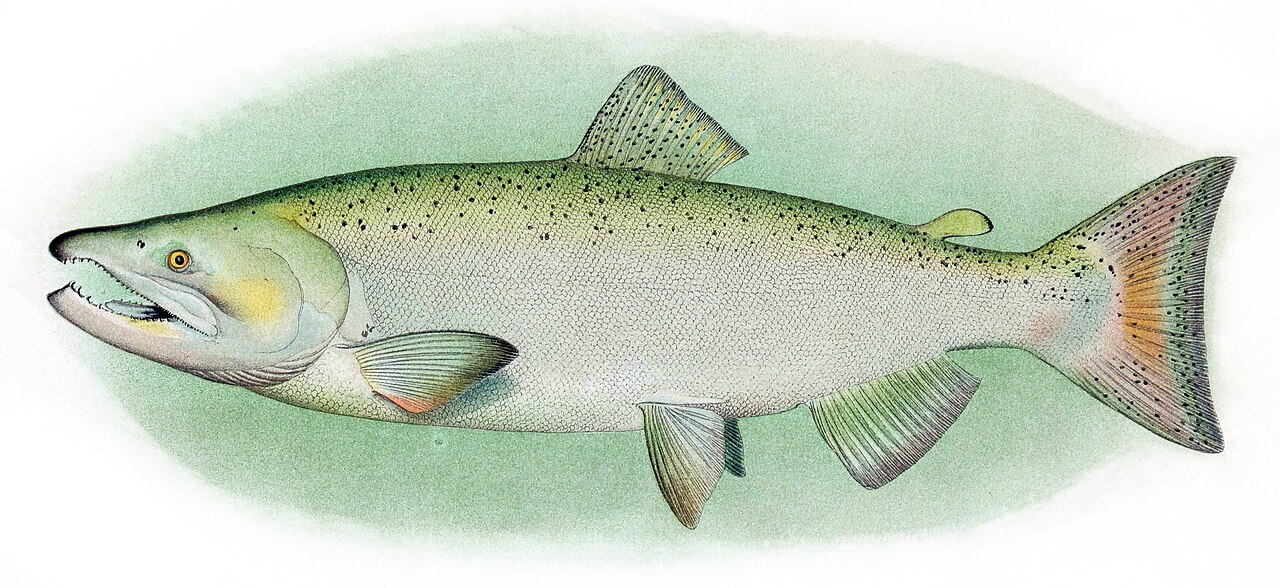
Oncorhynchus tshawytscha. Largest Pacific salmon; blue-green back, silvery sides, white belly, and black spots on the back and both tail lobes.
Photos
Click a photo to expand it for a closer look.

Identification
- Largest Pacific salmon; blue-green back, silvery sides, white belly, and black spots on the back and both tail lobes.
- Black pigment along the gum line gives Chinook the nickname 'blackmouth', a reliable field mark.
- Typical mature fish run about 3 feet and 30 pounds, though fish over 100 pounds are documented.
- All Chinook salmon die after spawning, unlike steelhead, which can survive to spawn again.
Top lures
- Trolling spoon (spoon , silver/chrome/glow white): Trolled behind a flasher in open water, standard tactics for lake-run and hatchery Chinook.
- Herring-imitating plug (crankbait , silver/blue/chrome): Trolled at depth to imitate baitfish, the main forage of larger Chinook.
- Hoochie squid skirt (soft plastic , green/glow white/UV chartreuse): Trolled behind a flasher, often tipped with bait for scent.
- Bucktail jig (jig , white/chartreuse): Cast or jigged near river mouths and current seams where fish stage before running upstream.
Top baits
- Cured herring or anchovy: Rigged on a trolling harness behind a flasher, a classic Chinook presentation.
- Sand shrimp: Fished whole below a slip sinker, drifted through deep holding water in rivers.
Line & tackle
- Line: 20–25 lb
- Rod power: Medium-heavy to heavy trolling or casting rod built for a large, hard-fighting fish
- Hook sizes: A 1/0 or 2/0 single hook for bait and drift rigs
Stocked behavior
Hatchery Chinook are reared in fresh water for three months to a year before release, depending on the run and hatchery, then migrate to sea to feed and grow before returning as adults, typically at age 3 or 4. Because Chinook always die after spawning, a hatchery-origin fish caught far upriver is always making its one and only spawning run.
Common mistakes
- Fishing gear sized for trout or smaller salmon; Chinook are the largest Pacific salmon and need heavier tackle.
- Fishing high in the water column; WDFW calls bottom always a good bet for Chinook, unlike coho, which often hold near the surface.
- Overlooking estuaries and terminal areas at river mouths, where trolling takes Chinook before they push upstream.
State records
| State | Weight | Angler | Water | Year |
|---|---|---|---|---|
| Washington | 68.26 lbs | Mark Salmon | Elochoman River, Wahkiakum County | 1992 |
Source: Washington's official record page , accessed 2026-09-19.
Where it's stocked
No stocking events recorded for Chinook Salmon yet.
Sources
- identification (accessed 2026-09-19)
- identification (accessed 2026-09-19)
- stocked_behaviour (accessed 2026-09-19)
- top_lures (accessed 2026-09-19)
- top_baits (accessed 2026-09-19)
- line_and_tackle (accessed 2026-09-19)
- line_and_tackle (accessed 2026-09-19)
- line_and_tackle (accessed 2026-09-19)
- common_mistakes (accessed 2026-09-19)
- common_mistakes (accessed 2026-09-19)