Crappie
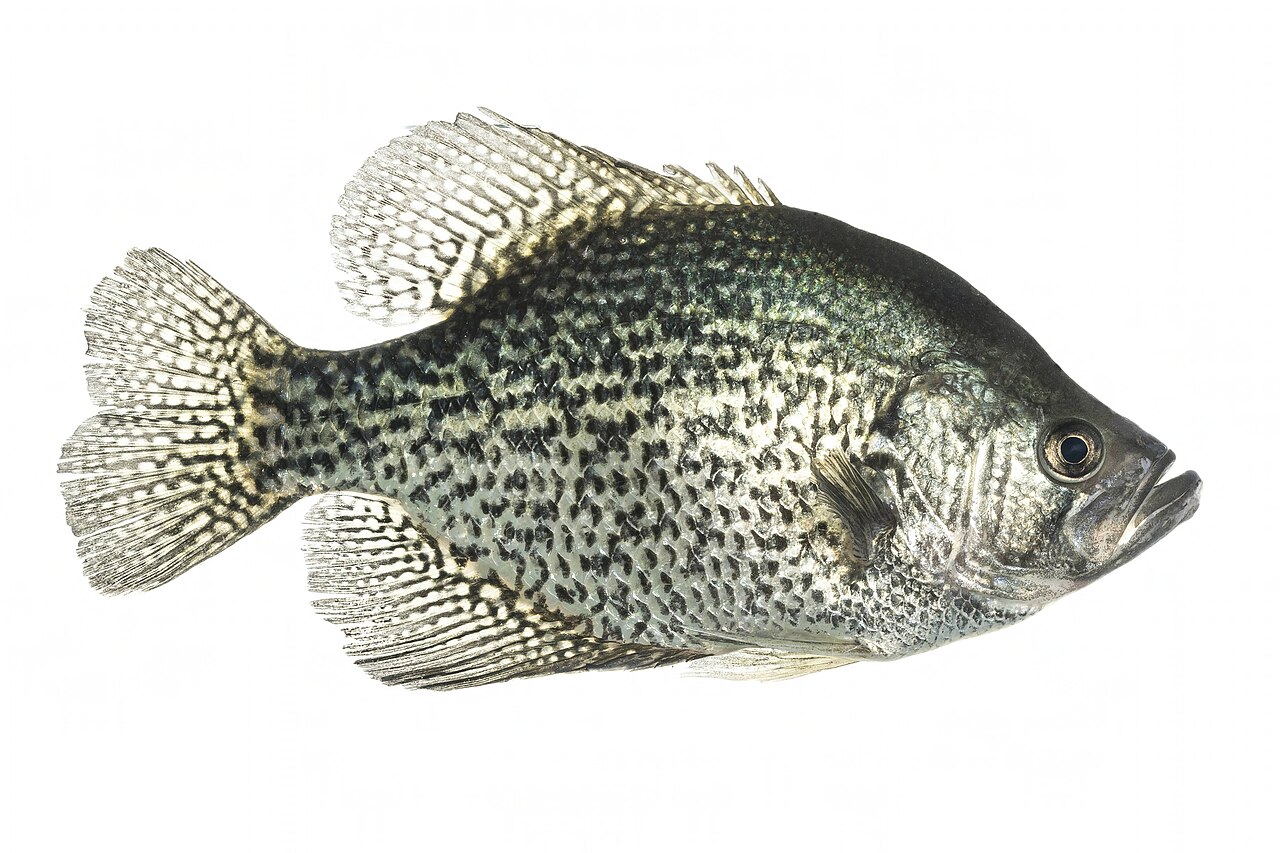
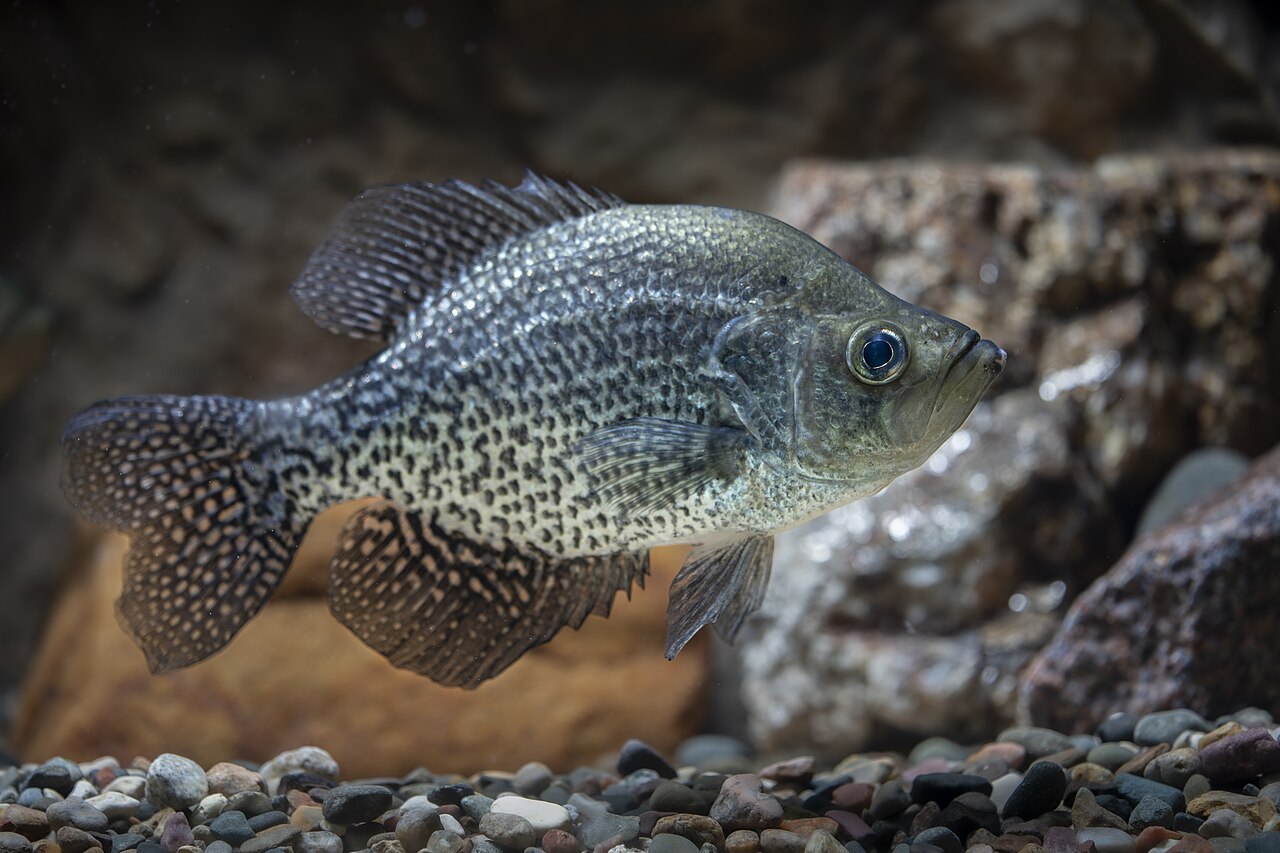
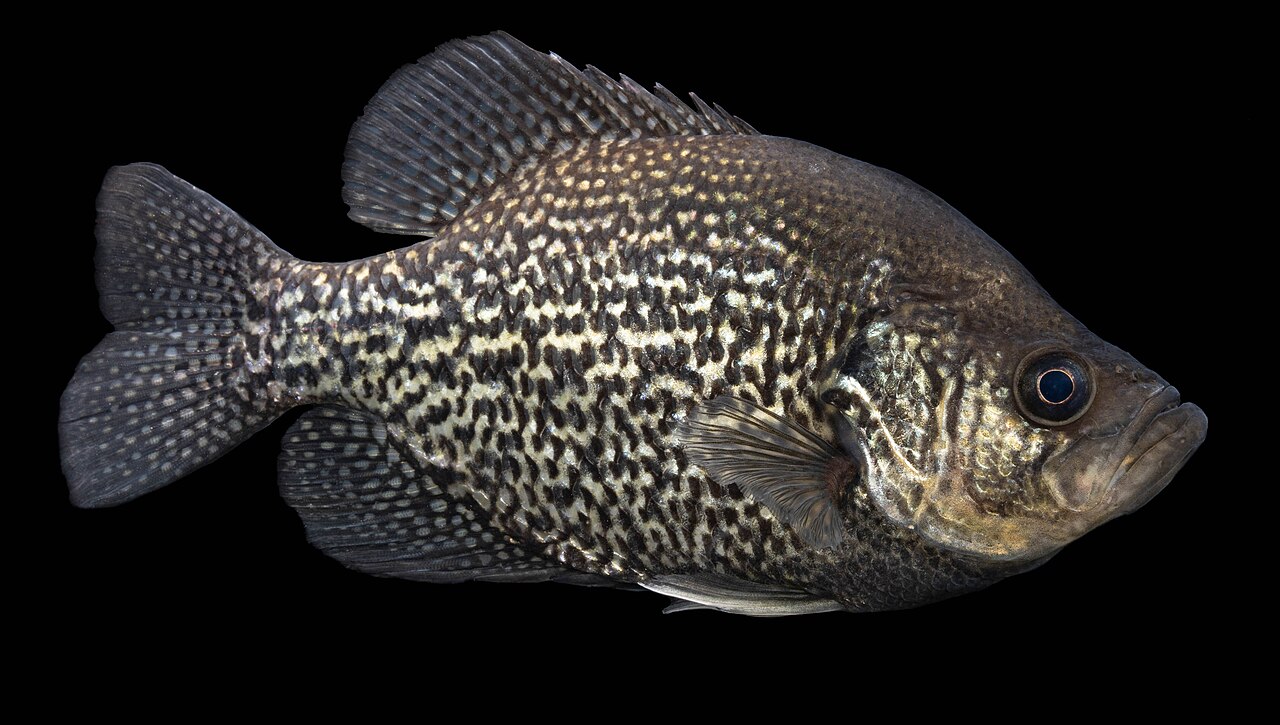
Pomoxis nigromaculatus. Deep, laterally compressed body with large, rounded dorsal and anal fins.
Photos
Click a photo to expand it for a closer look.

_(53084649608).jpg)

Identification
- Deep, laterally compressed body with large, rounded dorsal and anal fins.
- Silver-olive color with dark, irregular blotches on the sides rather than the vertical bars other panfish show.
- Black crappie have 7-8 dorsal spines and more scattered spots than white crappie, which has 6 dorsal spines and spots often aligned in bars.
- Typically 7 to 9 inches, with quality waters producing fish 9 to 15 inches.
Depth by season
| Season | Depth | Note |
|---|---|---|
| Spring | – | Fish school in shallow water to spawn as temperatures approach 55°F; the best window of the year. |
| Summer | – | Fish scatter after spawning and move into deeper water; the bite generally declines. |
| Fall | – | Fishing improves again as water cools, similar to other panfish and bass. |
| Winter | – | Ice-fishing opportunities exist over deeper structure. |
Active times
- dawn
- dusk
- night
Top lures
- Small tube jig (jig , white/chartreuse/black/chartreuse): Cast or vertically fished near cover and drop-offs, especially around spawning season.
- Curly-tailed grub on a jighead (jig , white/pink/chartreuse): Slow retrieve near brush piles, stumps, and dock pilings.
- Small casting spoon (spoon , silver/gold): Vertically jigged near deeper structure in summer.
- Small inline spinner (spinner , silver/chartreuse): Cast near structure and creek mouths, especially in spring.
Top baits
- Small minnow: Hooked through the lips or back on a light jighead or under a bobber; effective tipped onto a jig in cold water.
- Worm: Small piece tipped onto a jig or fished under a bobber near structure.
Line & tackle
- Line: 4–8 lb
- Rod power: Light spinning rod paired with a gentle hookset for crappie's thin, delicate mouth
- Hook sizes: Size 4, 6 or 8 hooks for minnows; 1/16 to 1/8 oz jigs
Stocked behavior
Like other panfish, crappie populations mostly sustain themselves through natural reproduction, so agencies typically stock them as fingerlings only when establishing a new fishery. Newly introduced fish relate immediately to submerged structure such as brush, stumps, and dock pilings rather than open water, matching the schooling, structure-oriented behavior of established adult crappie.
Common mistakes
- Setting the hook hard; crappie have thin, delicate mouths that tear easily, so a gentle hookset works best.
- Fishing open water instead of structure; crappie relate strongly to brush piles, stumps, and dock pilings.
- Overlooking low-light and night fishing; crappie move out of deep water toward shore at dawn, dusk and after dark to feed.
State records
| State | Weight | Angler | Water | Year |
|---|---|---|---|---|
| Washington | 4.50 lbs | John W. Smart | Lake Washington, King County | 1956 |
| Utah | 3 lbs. 5 oz. | James Maack | Lake Powell | 2009 |
Sources: Washington's official record page , Utah's official record page , accessed 2026-09-19.
Best time to fish Crappie
Computed from every real stocking date on record, not a general seasonal guess.
Utah
Most commonly stocked in May in Utah, based on 39 stocking events on record.
Where it's stocked
6 locations shown. Click a pin for details.
Utah
Sources
- identification (accessed 2026-09-18)
- identification (accessed 2026-09-18)
- depth_by_season (accessed 2026-09-18)
- active_times (accessed 2026-09-18)
- active_times (accessed 2026-09-19)
- common_mistakes (accessed 2026-09-19)
- active_times (accessed 2026-09-19)
- top_lures (accessed 2026-09-18)
- line_and_tackle (accessed 2026-09-18)
- stocked_behaviour (accessed 2026-09-18)
- line_and_tackle (accessed 2026-09-19)
- top_baits (accessed 2026-09-19)
- top_baits (accessed 2026-09-19)