Splake
Salvelinus namaycush x Salvelinus fontinalis. Hybrid cross between lake trout and brook trout; unlike most hatchery hybrids, splake are fertile and can reproduce.
Photos
Click a photo to expand it for a closer look.
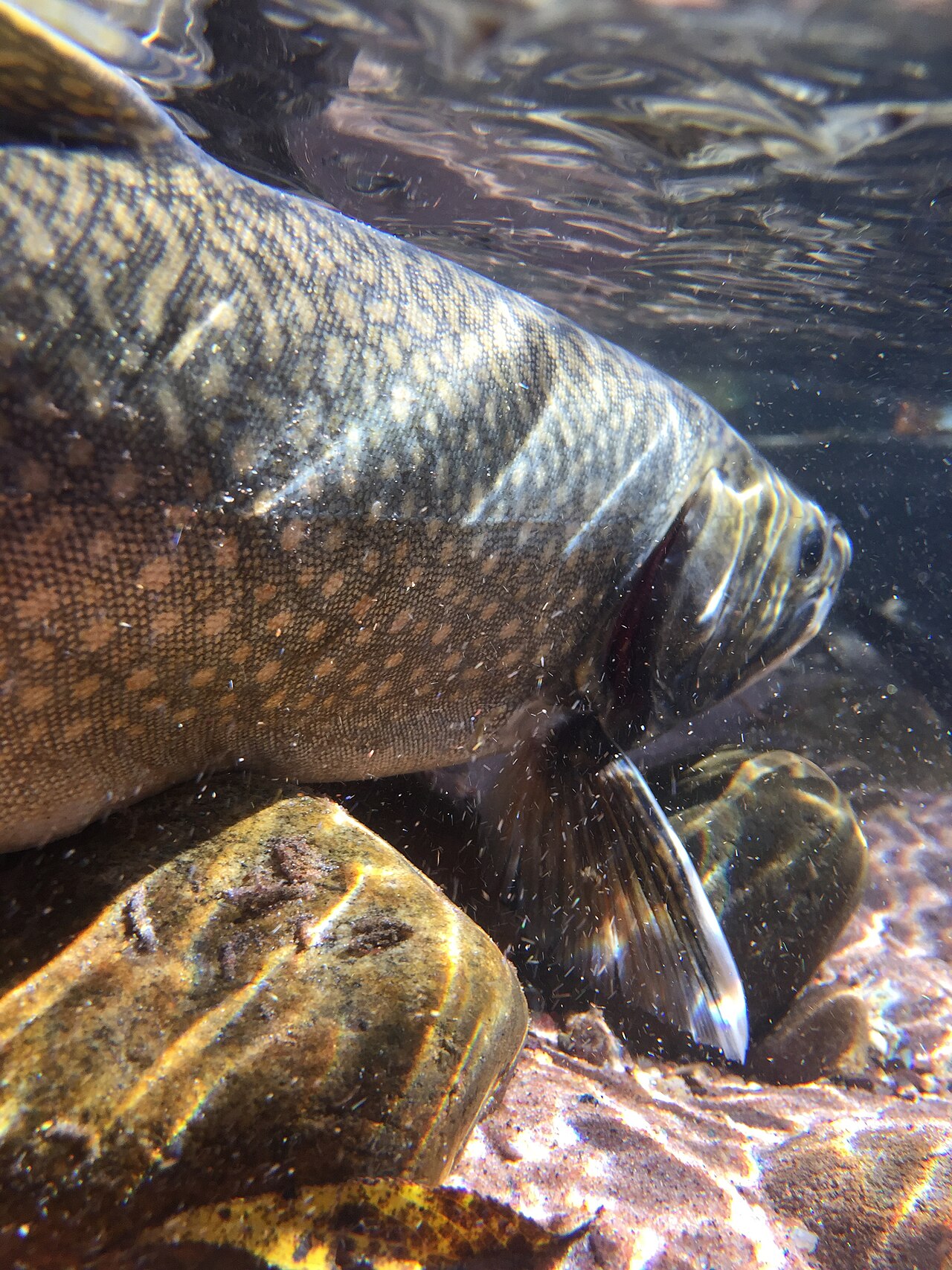

Identification
- Hybrid cross between lake trout and brook trout; unlike most hatchery hybrids, splake are fertile and can reproduce.
- Dark background with light spots; the tail is not as deeply forked as a lake trout's, sometimes nearly square like a brook trout's.
- Grows quickly, reportedly reaching about 18 inches within two years of being stocked as a fingerling.
- Coloration and habits vary fish to fish: some resemble drab, deep-holding lake trout, others bright, shallow-holding brook trout.
Depth by season
| Season | Depth | Note |
|---|---|---|
| Spring | – | Fish generally use nearshore areas, similar to brook trout habits. |
| Summer | – | Fish move to deeper, cooler water as the lake warms, similar to lake trout habits. |
| Fall | – | Fish return to nearshore areas as the lake cools, similar to the spring pattern. |
| Winter | – | Fish continue to use nearshore areas through the winter months. |
Top lures
- Small spoon (spoon , silver/gold/orange): Cast-and-retrieve or trolled near shore in spring and fall, deeper in summer.
- Small inline spinner (spinner , silver/gold): Cast in nearshore areas, standard tactics for stocked trout and char.
- Streamer fly (fly , white/olive/black): Stripped through nearshore water in spring and fall when fish hold shallow.
Top baits
- Nightcrawler: Still-fished near shore, a reliable option alongside lures.
- Cut bait or dead minnow (where legal): Fished near bottom or under a bobber; splake become fish-eating predators at a young age.
Line & tackle
- Rod power: Medium power spinning rod; Idaho steps up from ultralight for trout over 20 inches, and Colorado records splake to 18 pounds
Stocked behavior
Splake are maintained mostly through hatchery stocking as fingerlings, though the cross is unusual among hatchery hybrids in being fertile rather than sterile. They grow quickly once stocked, reportedly reaching about 18 inches within two years, and individual behavior varies between the deep-holding habits of a lake trout and the shallower, nearshore habits of a brook trout.
Common mistakes
- Expecting uniform behavior; splake vary fish to fish between lake-trout-like and brook-trout-like habits.
- Assuming a hybrid is sterile; splake are unusual in being fertile, and have backcrossed with brook trout in the Intermountain West.
- Judging size by age; splake planted as fingerlings can reach 18 inches in two years, but Intermountain West fish grow far slower.
State records
| State | Weight | Angler | Water | Year |
|---|---|---|---|---|
| Utah | 17 lbs. 4 oz. | Stacy S. Willden | Fish Lake | 2006 |
Source: Utah's official record page , accessed 2026-09-19.
Best time to fish Splake
Computed from every real stocking date on record, not a general seasonal guess.
Utah
Most commonly stocked in June in Utah, based on 114 stocking events on record.
Where it's stocked
9 locations shown. Click a pin for details.
Utah
Sources
- identification (accessed 2026-09-19)
- identification (accessed 2026-09-19)
- identification (accessed 2026-09-19)
- depth_by_season (accessed 2026-09-19)
- stocked_behaviour (accessed 2026-09-19)
- stocked_behaviour (accessed 2026-09-19)
- top_lures (accessed 2026-09-19)
- top_baits (accessed 2026-09-19)
- line_and_tackle (accessed 2026-09-19)
- line_and_tackle (accessed 2026-09-19)
- top_lures (accessed 2026-09-19)
- common_mistakes (accessed 2026-09-19)
- common_mistakes (accessed 2026-09-19)